
How Long Does an Ashes Tattoo Take to Heal In Total?
Key Takeaways
- An ashes tattoo takes two to three weeks for the surface to close and two to three months for the deeper layers of skin to fully settle.
- An ashes tattoo heals on exactly the same timeline as any other tattoo, because once prepared the ashes are blended into ink that behaves like ordinary tattoo ink in the skin.
- Bubblegum Ink seals the tattoo under a waterproof second skin for the first seven days, with nothing applied to it at all during that week.
- From day seven the second skin comes off and Bepanthen is applied generously morning and evening for the following seven days.
- The cloudy or faded look that worries people during healing is a thin layer of dead skin sitting over fresh ink, not the ashes failing to take.
- Ink appearing on flaking skin or bedsheets is surface shedding only, as the ashes and ink sit deep in the dermis below anything that flakes away.
- Signs that need a GP rather than patience are spreading redness, heat, growing swelling, yellow or green discharge, a bad smell or a fever.
- An ashes tattoo usually looks its sharpest around the three month mark rather than the day the scabs finish.
Around two to three weeks for the surface to knit over and roughly two to three months for the deeper layers of skin to fully settle. That’s the honest answer. The top layer looks healed fairly quickly. Underneath, your skin is still doing quiet repair work for weeks after it stops looking like anything is happening. An ashes tattoo heals on the same timeline as any other tattoo, because once the ashes are prepared and blended into a bespoke, particle-matched, high-quality tattoo ink, what goes into your skin behaves like ordinary ink. Same scabbing, same flaking, same itch. The memory in it doesn’t change the biology.
What does change is how much of that you see, because a waterproof second skin covers the tattoo for the first seven days and a week of Bepanthen follows once it comes off. So you get two timelines running at once: the one you can see and the one you can’t, plus a covered week in between where very little is visible at all. Most people only track the first and worry when it seems slow. Knowing all of it helps.
What Do The First Two Weeks Of Healing Look Like?
For the first seven days, very little of this is visible, because the tattoo is sealed under a waterproof second skin. Underneath it, the same process is happening as any fresh tattoo: warmth and tenderness in the first day or two, a thin clear fluid mixed with a little ink pooling against the film rather than weeping onto a dressing, then a tightening, scabbing and flaking stage from around day three to six that you’ll mostly feel rather than see. That’s normal. Don’t peel the film early to check on it. What you do in the first 48 hours after an ashes tattoo sets up the whole fortnight, so it’s worth getting that early window right even though most of it happens out of sight.
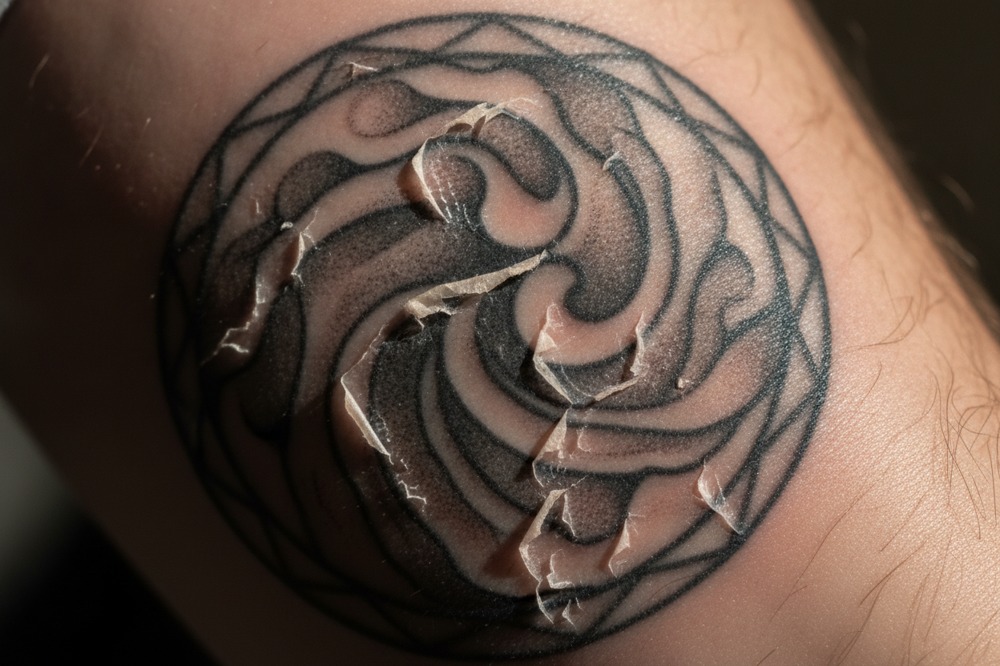
On day seven the second skin comes off, you do the first proper wash and Bepanthen takes over for the next seven days. This is when the visible flaky, patchy stage most people associate with tattoo healing plays out, and it can look a bit rough, dull, almost cloudy in places. You might see a little ink-coloured skin come away on your bedsheet during this week; that’s fine, it’s the surface shedding, not the tattoo leaving. People panic here and think their mum’s ashes tattoo has faded or the ashes didn’t take. It hasn’t. There’s a thin layer of dead skin sitting over the fresh ink like frosted glass. Once that sheds you’ll see the real colour underneath.
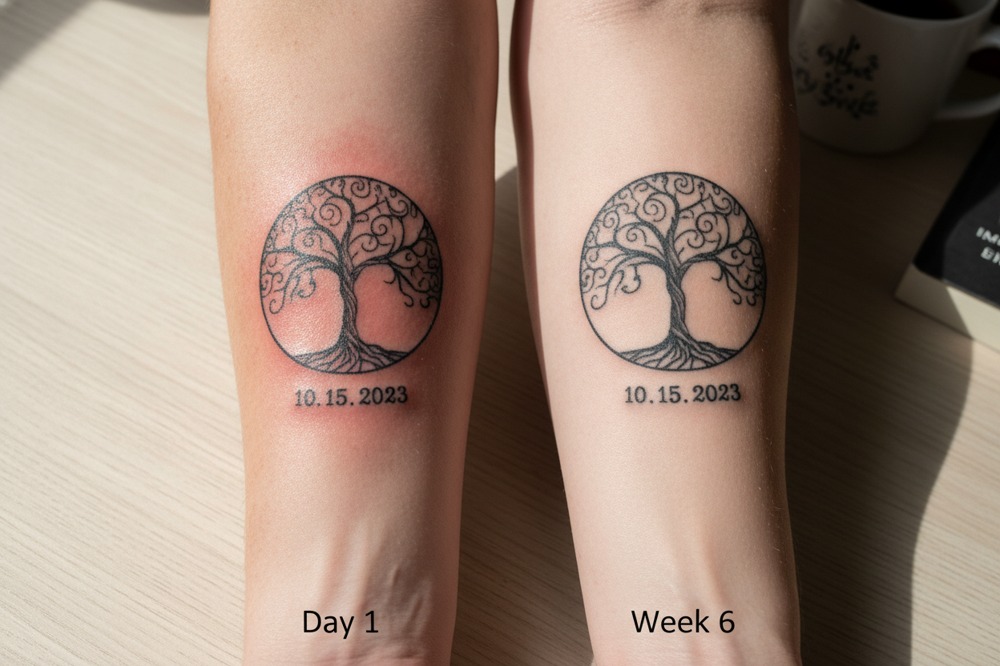
By roughly day fourteen, at the end of the Bepanthen week, the surface is closed for most people. No open skin, no scabs. That’s the point most folk call it healed. It isn’t quite, but it looks it.
Why Does The Deeper Healing Take A Few Months?
Here’s the part nobody tells you. The skin has layers. The scabbing and flaking you possibly went through in week two, once the second skin came off, was only the outermost bit, the epidermis, closing over. The dermis, where the ink and the ashes live, takes far longer to settle back into place.
For two to three months after the surface looks done, that deeper layer is still knitting. During that stretch the tattoo can look slightly hazy or matte, like there’s a faint film over it. Then one day the film lifts and the lines look crisper and the colour looks richer. That’s the dermis finishing. It’s why a tattoo often looks its best at the three-month mark rather than the two-week mark. Patience pays off with an ashes piece more than most, because it’s the one tattoo you never want to second-guess.
This deeper phase is also why aftercare doesn’t stop once the Bepanthen week ends. Keeping the skin fed and out of strong sun for those first few months protects how the ashes-carrying ink settles. The full ashes tattoo aftercare guide walks through the whole span, not just the noisy first fortnight.
What Makes An Ashes Tattoo Heal Faster Or Slower?
Placement matters more than anything. A tattoo on your forearm or calf heals quicker and cleaner than one on your ribs, foot, hand or anywhere that rubs, bends or gets knocked all day. Hands and feet are notorious for slow, patchy healing because the skin’s thinner and always in use.
Size and detail come next. A small script of your dad’s handwriting will surface-heal at the fast end of the range. A large colour portrait covering a shoulder is a bigger wound and takes longer at every stage. Colour and heavy shading also tend to scab a touch more than fine linework.
Then there’s you. Age, general health, whether you smoke, how well you sleep, whether you’re on certain medications, how much you drink in that fortnight. Younger skin bounces back faster. If you’re run down or stressed and grief does both, healing can drag a little. That’s worth knowing rather than worrying about. Give yourself grace here. And if you’ve ever wondered whether the ashes themselves slow anything down or raise a risk, they don’t when they’re prepared properly, which is the whole point of are ashes tattoos safe as a question worth asking any studio before you book.
How Do You Know It’s Healing Properly And Not Going Wrong?
Healthy healing is boring and boring is exactly what you want. Mild warmth and tenderness while the second skin’s sealed on, some tightness and itching once you’re into the Bepanthen week, dry flaking as that week goes on. All of that is the tattoo doing its job.
What you’re watching for instead: redness that spreads outward and gets worse rather than better, heat coming off the skin, swelling that grows, yellow or green discharge, a bad smell, or a fever. Those aren’t healing and they mean phone your GP, whether you notice them through the second skin in week one or once it’s bare in week two. They’re uncommon with a clean, properly prepared tattoo, but you should know the difference. There’s a fuller run-through of the signs of healthy tattoo healing if you want to check yours against a list while it settles.
One more reassurance. A bit of ink coming away on your flaking skin during the Bepanthen week, or a small scab lifting with a fleck of colour in it, doesn’t mean the ashes have washed out or the memorial is ruined. The ashes and ink sit deep in the dermis, well below anything that flakes off the top.
What Should You Put On It And When Do You Ease Off?
For the first seven days you put nothing on it at all. The second skin is sealed over the tattoo and stays that way, no touching, no product, no peeking. Leave it entirely alone and let it do its job.
On day seven, once the film comes off, the first proper wash is plain lukewarm water, no soap needed. From there it’s Bepanthen for the following seven days, applied generously, morning and evening at the very least. Unlike a lot of aftercare balms, you genuinely can’t overdo it with Bepanthen, so don’t hold back worrying about clogging the skin.
Around the two-week mark, once the Bepanthen week is done and the flaking’s finished, you can switch to a plain unscented moisturiser to keep the skin supple through that longer deep-healing stretch. Which products suit which stage is covered properly in the ashes tattoo aftercare products rundown, including what to avoid. The two hard rules for the whole healing span: keep it out of soaking water, so no baths, swimming pools or the sea until it’s fully closed, even though the second skin is waterproof enough for a normal shower, and keep it out of direct strong sun, which fades fresh ink faster than almost anything.
Does Keeping The Ashes In View Change Anything About The Session Or Healing?
It doesn’t change the healing at all, but it’s worth explaining how the day itself works, because it settles a worry a lot of people carry in. Your loved one’s ashes sit on the workbench in front of you the whole time, in plain sight. Nothing is carried off to a back room. The small amount needed, roughly a teaspoon’s worth, is prepared right there where you can watch every step. If handling the ashes yourself feels like too much, that’s completely understood and it’s done gently for you while you watch or look away, whatever you can manage.
There are two easy ways to handle bringing them. You can bring the whole container along and let Paul lift out what’s needed himself, which suits anyone who’d rather not touch them at all. Or you can measure out a small amount at home beforehand and just bring that. Either way, the rest goes home with you the same day. Nothing more than that teaspoon’s worth is used and what’s left is yours to take back, which matters to a lot of people who want to keep the bulk of the ashes together.
The experience behind the process is really about steadiness on a hard day. Paul has tattooed for over thirty years and the last twenty plus of those the work has centred on ashes tattoos specifically. On the healing side, that translates into straight answers when you ring up three days in convinced something looks wrong and it almost always doesn’t. The whole appointment happens in a private, one to one studio, not on a busy shared floor, so you’re not healing an emotional day in front of strangers either.
FAQ
How Long Before An Ashes Tattoo Stops Scabbing And Peeling?
Not much happens visibly in the first seven days, since the tattoo is sealed under the second skin. The visible scabbing and flaking mostly run from day seven, once the film’s off, through the Bepanthen week to around day fourteen, when the surface has shed its dead skin and closed over for most people. Picking or scratching at flaking skin early can drag out this stage and pull colour, so let it lift on its own.
Why Does My Ashes Tattoo Look Faded Or Cloudy While Healing?
That hazy, dull look shows up twice: as cloudy pooled fluid under the second skin in week one, and again as a thin layer of healing skin sitting over the fresh ink during the Bepanthen week, like frosted glass either time. It’s not the ashes failing to take or the tattoo fading. Once that layer finishes shedding and the deeper skin settles over the following couple of months, the true colour and crispness come through.
Can I Shower Or Wash Normally While It Heals?
Yes throughout, though what that means changes by week. For the first seven days you can shower completely normally, the second skin is fully waterproof. From day seven, once you’re on Bepanthen, keep showers gentle and lukewarm rather than hot. What you avoid the whole way through, until it’s fully closed at around two weeks, is soaking it: no baths, swimming pools, hot tubs or the sea. Soaking softens scabs too early and raises the infection risk.
Is It Normal To See Ink On My Skin Or Bedsheets During Healing?
Not in the first week, the second skin keeps everything sealed against your sheets. Once the film’s off and you’re into the Bepanthen week, it’s common to see a little ink weep out or come away on flaking skin and bedding. It looks alarming but it’s only surface ink shedding with the dead skin. The ashes and ink that make up your memorial sit deep in the dermis, far below anything that flakes off the top.
When Will My Ashes Tattoo Be Fully Healed?
The surface heals in about two to three weeks, seven days sealed under the second skin followed by a week of Bepanthen and a few more days settling. The deeper layers of skin, where the ink and ashes live, keep settling for another two to three months after that. It usually looks its sharpest and brightest around the three-month mark rather than the day the scabs finish.
Does An Ashes Tattoo Take Longer To Heal Than A Normal Tattoo?
No. Because the prepared ashes are blended into a bespoke tattoo ink that behaves like ordinary ink in the skin, an ashes tattoo heals on exactly the same timeline as any other tattoo of the same size and placement. The presence of the ashes doesn’t slow it down.
Still Worried Yours Is Taking Too Long?
If you came here counting days and quietly panicking that your tattoo looks slow, hazy or patchy, that feeling is the most normal thing in the world and nine times out of ten what you’re seeing is healing running exactly to plan. If something genuinely doesn’t sit right, or you just want to talk through what you’re looking at before you book at all, get in touch. Call the Sandbach studio on 01270 385001 or email info@bubblegumink.com. You can send a photo and get an honest read on it. No pressure, no rush, just a straight answer from someone who’s watched thousands of these settle.
Written by Paul.