

Cremation Ashes Tattoo Aftercare, Best Practice
Key Takeaways
- Bubblegum Ink uses a second-skin film dressing that stays on for seven days, so there is no daily washing, no moisturising and no touching the tattoo at all in the first week.
- The film is waterproof and breathable, so showers, baths, work, sleep and normal exercise all carry on as usual, though swimming and the sea are best left until it comes off.
- Remove the film on day seven in a warm shower, peeling slowly at a low angle parallel to the skin rather than pulling straight up.
- After the film comes off, a thin layer of Bepanthen up to four times a day is all that is needed, and only when the skin feels dry.
- The sealed film matters more for an ashes tattoo than a conventional one, because the prepared ashes finish encapsulating into the dermal layer during those first few days and a no-touch week lets that complete cleanly.
- The tattoo surface is healed when the film comes off on day seven, while the deeper dermal layers continue settling for six to twelve weeks.
- Sun protection at SPF 30 or higher is the single most important thing for keeping a healed ashes tattoo sharp, as UV is what fades tattoos over time.
- Call Bubblegum Ink if the film fails before day seven, if redness spreads well beyond the tattoo, if there is sustained heat after three or four days, or if pain is worsening rather than easing.
- Bubblegum Ink has refined this aftercare method alongside its ashes preparation across thousands of memorial pieces over more than 20 years.
Aftercare for an ashes tattoo at Bubblegum Ink ® is genuinely simple. Easier than the aftercare for almost any other kind of tattoo, and easier than most clients expect when they arrive on the day. We use a second-skin film dressing that stays on for seven days, after which the tattoo has all but finished healing. No daily washing routine. No constant moisturising. No fiddling. No touching the tattoo at all for the first week. And the result is a memorial piece that heals faster, cleaner, and with a better long-term finish than any other aftercare protocol delivers.
Whether your tattoo is for a parent, a grandparent, a dog, a cat, a horse, or any other pet, the aftercare is the same. Whether the design is a paw print, a handwriting piece, a portrait, or any other memorial design, the aftercare is the same. The film does the work. You go about your life.
This page covers the full process from the moment you walk out of the studio to the moment the tattoo is fully settled. Written aftercare instructions also go home with you on the day, but if you’d like to read ahead or come back to a reference during the week, this is it.
Our Process At A Glance
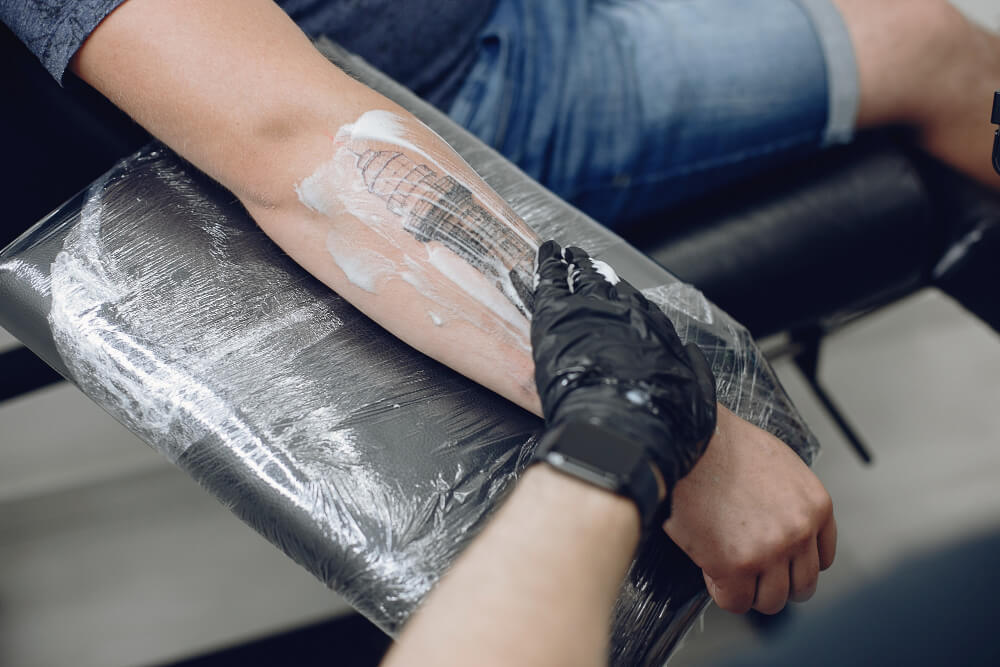
At the studio: Once your tattoo is finished, we apply a second-skin film dressing over the work. The film is waterproof, breathable, transparent, and designed to stay sealed against your skin for the full healing window.
Days 1 to 7: Leave the film on. Don’t touch the tattoo. Don’t peel at the edges. Carry on with your normal life. Showers, baths, work, sleep, exercise. The film handles all of it. The tattoo underneath heals undisturbed.
Day 7: Remove the film carefully (instructions further down on this page). Wipe the tattoo down with warm water. Pat dry. The tattoo is now all but healed.
After day 7: Apply a thin layer of Bepanthen four times a day if it feels dry. If it doesn’t feel dry, you don’t need to apply anything. Most clients find a few light applications over the first day or two of post-film life is plenty.
That’s the entire aftercare protocol. No twice-daily washing. No constant moisturising. No worrying about which fragrance-free soap to use. The film does the heavy lifting, and the result is consistently better than any open-healing approach.
Why The Second-Skin Method Works So Well
The reason we use this method, particularly for ashes tattoos, is that it’s the cleanest possible way to heal a tattoo. The film creates a sterile sealed environment over the work. Your skin’s natural plasma stays trapped against the surface where it’s supposed to be, doing its job of forming the protective layer that becomes the new skin over the tattoo. Bacteria, dust, and surface contamination from the outside world stay outside the seal. There’s no opportunity for the client to disturb the tattoo with washing, scratching, or accidental touches during the most fragile phase of healing.
For ashes tattoos specifically, this matters more than usual. The prepared ashes are encapsulated into the dermal layer along with the pigment during the tattoo process, but those first few days of healing are when the encapsulation finishes setting properly. A no-touch protocol gives that encapsulation the best possible chance to complete cleanly, with no movement of pigment or particles caused by skin disturbance. The result is a more even infusion, sharper line definition, and a finish that holds its appearance for decades.
Twenty years plus of refining this approach across thousands of memorial pieces has shown us, consistently, that ashes tattoos heal faster, sharper, and with better colour retention this way than they ever did under traditional open-healing aftercare. It’s also significantly easier on the client, who doesn’t need to spend a week worrying about whether they’ve done the aftercare properly.
Living Normally With The Film On
Most clients ask whether the film really lets them carry on normally. It does, in every way that matters.
Showers and baths. Both fine. The film is fully waterproof. You can take long showers, deep baths, hot baths, or whatever you’d usually do. The water rolls off the surface and the seal stays intact.
Swimming and the sea. Best avoided as a precaution, simply because pool chemicals and sea salt are unfriendly to healing tissue if any seal failure happens. Most clients save these for after the film comes off.
Work, exercise, sleep. All fine. The film moves naturally with your skin. Sweating doesn’t compromise the seal. Pressure from clothing or bedding doesn’t compromise the seal. The tattoo can’t be felt much through the film, and most clients forget it’s there within a day or two.
Clothing. Wear what you normally would. Loose layers over the tattoo are slightly more comfortable in the first day or two, but tight clothing won’t damage anything.
Driving. No issue. Whatever you’d normally do, do.
Touching it. Don’t. Even if it itches a little under the film (it sometimes does, briefly, around days 3 to 5), resist. The whole point of the film is that the tattoo isn’t touched at all for the full week.
Pulling at the edges. Also don’t. If the edges of the film start to lift slightly, that’s fine. You can carefully press them back down with clean hands, but don’t try to remove the film or replace it. The seal in the centre is what matters most.
If the film comes off completely before day 7. Get in touch and we’ll advise. This is uncommon. We can sometimes apply a fresh film if it’s a fresh failure, or we’ll move you onto a brief open-healing protocol for the remaining time.
Removing The Film On Day 7
Removal is straightforward but worth doing carefully. Don’t rush it.
The easiest method: Remove the film while you’re in the shower, with warm water running over the area. The water softens the adhesive and the film comes away cleanly. Find an edge, peel slowly at a low angle (parallel to your skin rather than straight up), and let the warm water work between the film and your skin as you pull. The whole removal should take a minute or two.
What you’ll see underneath: The tattoo will look settled, clean, and slightly shiny. There may be some accumulated plasma or fluid trapped against the skin under the film. This is completely normal and is part of why the healing has worked so well. It rinses away with the warm water.
After the film is off: Wipe the tattoo gently with warm water (no soap needed) to remove any residue. Pat dry with a clean paper towel. The tattoo is now healed enough that the surface is intact and the dermal pigment is properly set.
If you find the film difficult to remove: Don’t force it. Soak the area in warm water for a few minutes longer. If a particularly stubborn corner won’t come away cleanly, leave that small section in place for a few hours and try again with more warm water. The adhesive eventually softens completely.
After The Film Comes Off
From day 7 onwards, the tattoo is mostly self-sufficient. The most useful thing you can do is apply a thin layer of Bepanthen up to four times a day, but only if the area feels dry or tight. If the skin feels comfortable and not dry, you don’t need to apply anything at all.
Bepanthen specifically is a fragrance-free, simple healing cream that’s well-suited to fresh tattoos. It’s available from any UK chemist. We recommend it because it’s reliable, gentle, and doesn’t contain any of the heavy perfumes or active ingredients that some other tattoo aftercare creams include. A small tube goes a long way. Apply a thin layer (the cream should disappear into the skin within 30 seconds, not sit on top in a thick smear) and only when the skin feels dry.
Most clients find they need a few light applications over the first one or two days post-film, and after that the tattoo settles into its long-term appearance. The full healing of the deeper dermal layers continues for around six to twelve weeks, but the surface is healed and the tattoo is safe from external contamination from the moment the film comes off.
Long-Term Care
Once the tattoo is fully healed, the single most important thing for keeping it looking sharp is sun protection. UV light is what fades tattoos over time. Use sunscreen at SPF 30 or higher on any visible tattoo when you’ll be outside for more than a short period, and the work will hold its colour and clarity for decades.
Beyond that, normal skin care is fine. Regular moisturising helps. We use specialist light-fast pigments specifically chosen for longevity, so the work stays vibrant. The tattoo, including the ashes infused into it, is permanent. The connection to your loved one or pet is yours for the rest of your life.
When To Get In Touch
The second-skin method has an excellent track record over twenty years of work. Issues are very very rare. But if you see any of the following, give us a call, as we care.
- The film comes off completely before day 7.
- Significant redness spreading well beyond the tattoo into the surrounding skin.
- Sustained heat at the site after the first three or four days.
- A fever, particularly with any other symptoms.
- A rash, hives, or significant skin reaction either under or around the film.
- Significant pain that’s getting worse rather than better.
- Any other concern that doesn’t seem right.
Call 01270 385001 during studio hours, or email info@bubblegumink.com. The track record on the second-skin method is excellent, and reactions are very rare with our prepared ink, but if anything looks off we want to be the first call you make. Our are ashes tattoos safe page covers more on what makes the preparation safe and why reactions are extremely rare.
Frequently Asked Questions
Can I really shower normally with the film on?
Yes. The film is waterproof and the seal holds up to normal showering, bathing, and washing. Most clients shower as they normally would from the day of the appointment onwards.
What if water gets under the film?
A small amount of moisture under the film is normal and not a problem. Significant pooling of water under the film, with visible water movement when you press the area, is a sign the seal has failed and you should get in touch.
Can I exercise during the seven days?
Yes. Light to moderate exercise is fine. The film moves with your skin and sweat doesn’t compromise the seal. We’d avoid contact sports or anything that might cause direct impact on the tattoo, but normal cardio, gym work, walking, and sport are all fine.
Will the film come off in the shower?
Not under normal use. The adhesive is designed to hold against water. The film only comes off cleanly when you’re actively peeling it on day 7, even though warm water is what makes that easier.
The edges of the film are lifting slightly. Is that a problem?
Usually no. Lift in the corners or along an edge is common and doesn’t usually compromise the seal in the centre. Press the lifted edges down gently with clean hands. Don’t try to replace or remove the film unless it’s failed completely.
Can I sleep on the tattoo?
Yes. The film protects the tattoo from pressure and friction during sleep. Most clients find within a day or two they don’t notice it.
Why don’t I need to wash the tattoo every day during the seven days?
Because the film is sealed. Bacteria can’t reach the tattoo, and the plasma your skin produces in the early healing stage stays where it’s supposed to. The whole point of the method is that the tattoo doesn’t need to be cleaned because nothing is contaminating it.
Why Bepanthen specifically?
It’s a simple, fragrance-free healing cream that’s well-tolerated and easy to find at any UK chemist. We’ve used it successfully on healed tattoos for years. It absorbs into the skin without leaving a heavy film, and it has none of the perfumes or active ingredients that some other tattoo aftercare products carry.
Can I use a different cream after the film comes off?
Bepanthen is what we recommend, as we know that its widely available and work fantastic with our inks. Avoid heavily perfumed creams, anything with active ingredients (acids, retinols, vitamin C serums), and anything with petroleum jelly as the main base.
My tattoo looks slightly cloudy after I take the film off. Is that normal?
Yes. Some cloudiness in the first day or two after film removal is normal and clears as the surface fully matures. The full colour and clarity comes back within a few days.
How long until I can swim?
Once the film is off and the tattoo has settled (typically a few days after day 7), swimming is fine.
Will my tattoo be ‘fully healed’ on day 7 when the film comes off?
The surface is healed and protected from external contamination. The deeper dermal layers continue settling for six to twelve weeks, but the tattoo has all but finished healing and is safe to live with normally from day 7.
Why is this aftercare different from what other studios tell me?
Because most generalist studios don’t use the second-skin method, particularly for memorial work. Our process was developed alongside our specialist ashes preparation over twenty years, and the combination of properly prepared ink and second-skin healing produces a sharper, faster-healed result than any open-healing protocol can match.
Will the ashes ever ‘come out’ of the tattoo?
No. The prepared ashes are permanently embedded in the dermal layer along with the pigment. They’re part of the tattoo for life.
Will the tattoo hurt during healing?
Some tenderness in the first day or two is normal, similar to a mild sunburn. Once the film has been on for a day or two, most clients say they barely notice the tattoo at all. Our do ashes tattoos hurt page covers pain during the appointment itself.
Other Useful Pages
If you haven’t yet had your appointment and are reading this in advance, our do ashes tattoos hurt, how much ashes for a tattoo, and are ashes tattoos safe pages cover the other most common pre-booking questions.
Our main ashes tattoos hub page covers the work more broadly, and our tattooing ashes into clients page covers what the appointment day itself is like, end to end.
We also looking into this subject even more with our Guide To Ashes tattoo Aftercare on our website.
Bubblegum Ink ® is in Sandbach, Cheshire. To book or to ask any questions, use the contact page or call 01270 385001.
This page was written by Paul Cutler, founder of Bubblegum Ink ®. A tattoo artist of over 30 years, he has spent more than the last 20 specialising in cremation ashes tattoos and has refined this aftercare method across thousands of memorial pieces. His work has featured on the BBC and in national and international press. Read more about Paul.