
Cremation Ashes Tattoos Explained
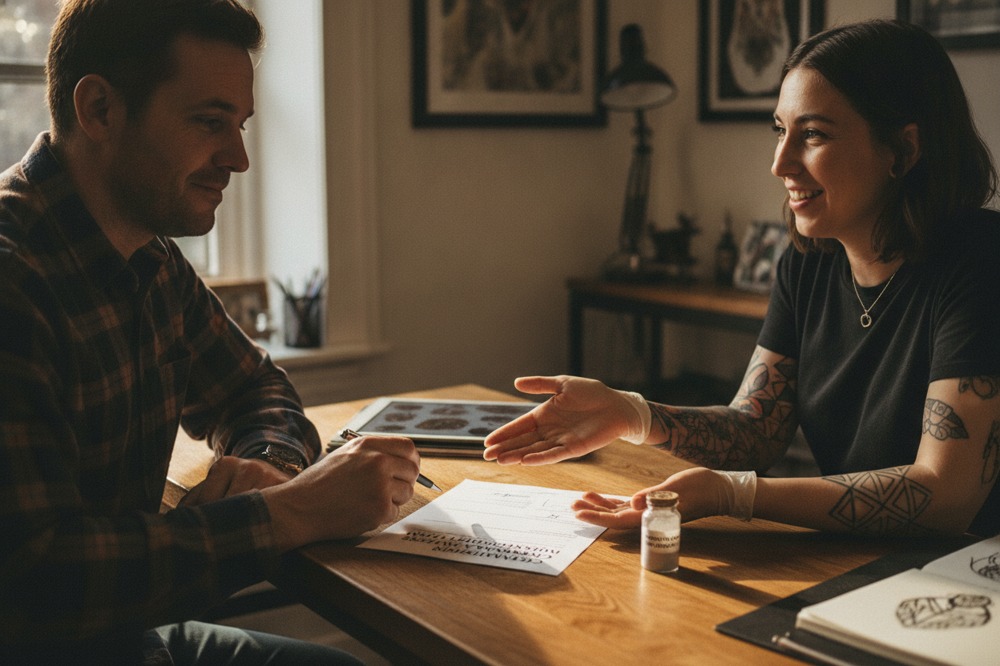
Most people who ask me to explain cremation ashes tattoos are really asking one quiet thing first: is any part of my loved one in there, or is this just a nice idea with a name? So let me answer that plainly. Yes, a small amount of the prepared ashes goes into the ink that’s tattooed into your skin, so the finished piece genuinely carries part of the person or pet you’ve lost. The ashes are matched to the right particle size, cleaned, sterilised to clinical standards and cleared of contaminants, then blended into a bespoke, particle-matched, high-quality tattoo ink that I prepare for this. From there it’s tattooed the same way any tattoo is. That’s the whole idea in one breath. Everything below is the detail behind it.
What Goes Into The Skin In An Ashes Tattoo?
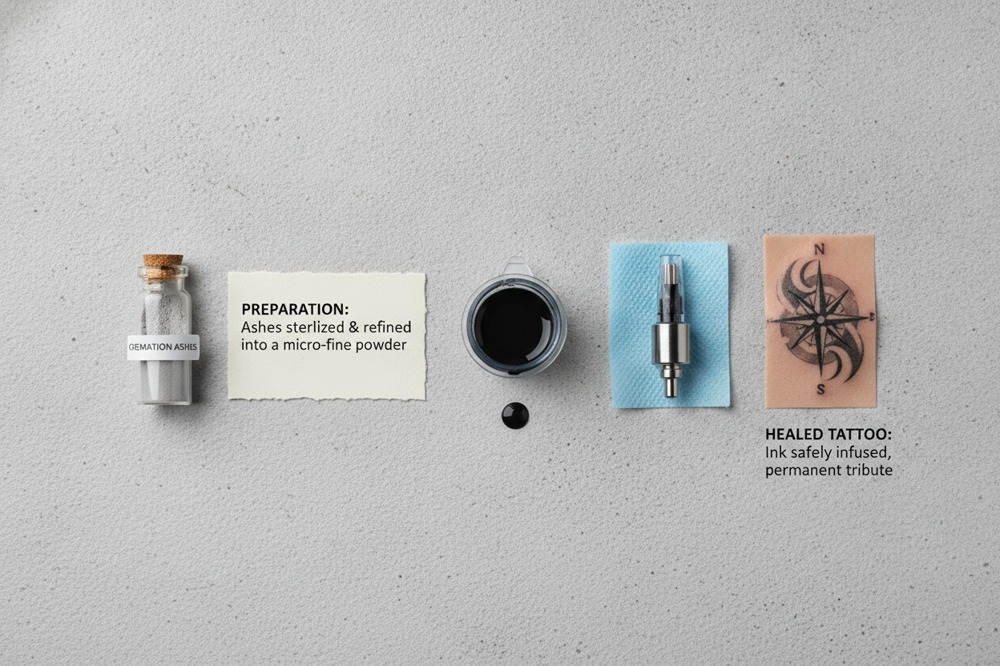
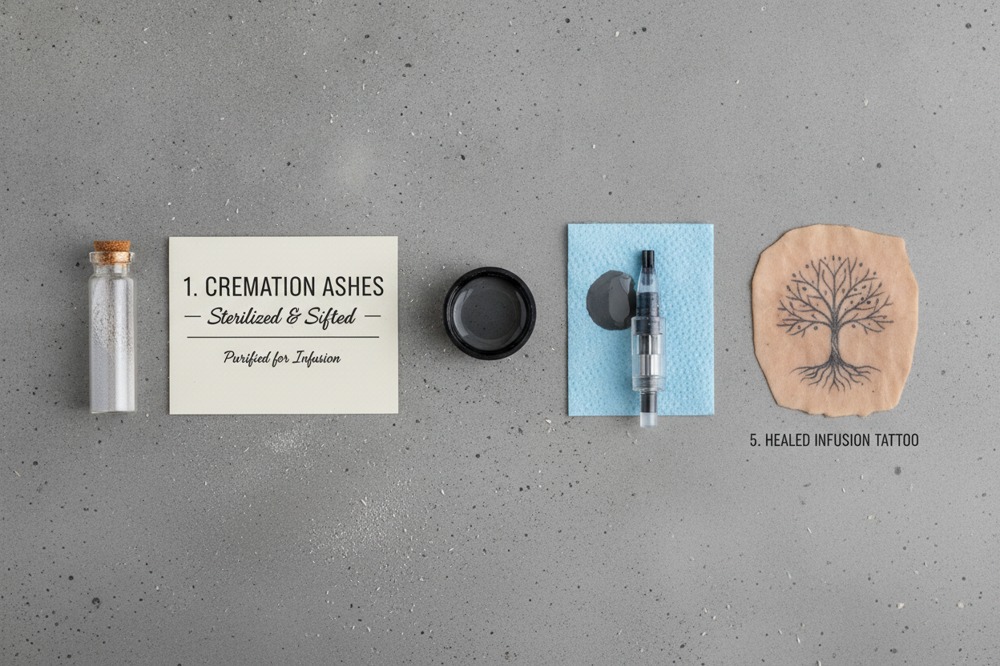
Raw ashes straight from the urn can’t go into skin. They’re too coarse and they carry bits you don’t want under there. So the first job is preparation. The ashes get matched to a fine particle size, cleaned, sterilised and cleared of contaminants. Only then are they blended into the bespoke ink.
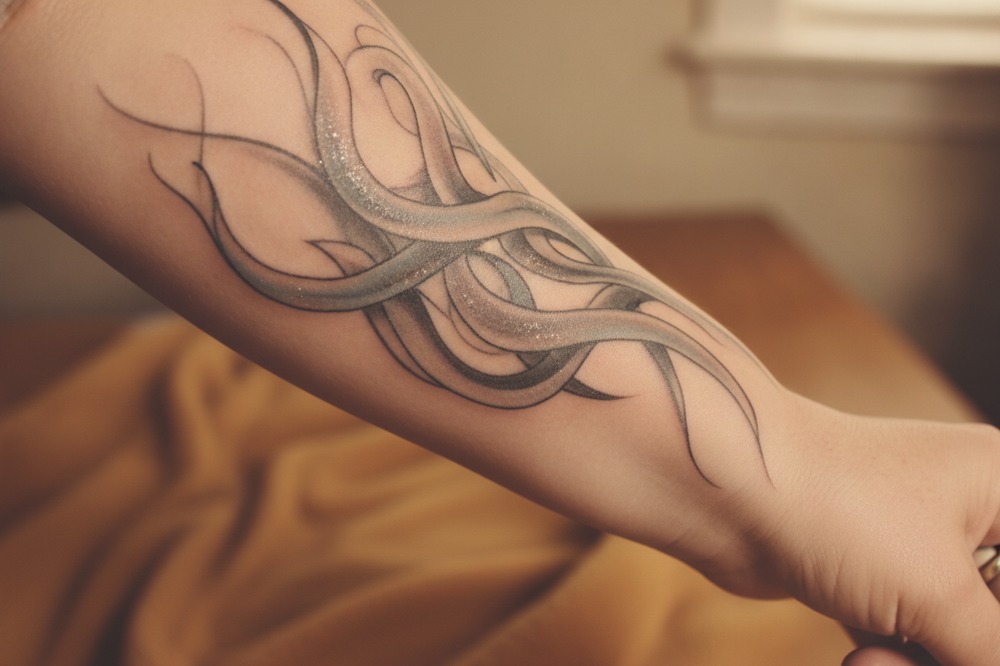
What you end up with isn’t cremated remains sitting in a lump under your skin. It’s a prepared, sterile pigment that carries your loved one, mixed evenly through the ink so it disperses the way any colour would. Once it’s healed you can’t see “the ashes” as a separate thing. You see the tattoo. It’s the knowing that matters and the fact that it’s true.
One thing people get wrong: they picture some grainy, textured patch. It isn’t that. In the skin it behaves like ordinary ink, same sensation going in, same healing after. The difference is entirely in what the ink is, not in how it feels or looks day to day.
How Are The Ashes Prepared Before They Become Ink?
This is the part that separates a proper ashes tattoo from someone stirring a bit of grey dust into a cap and hoping. Preparation is the whole safety story.
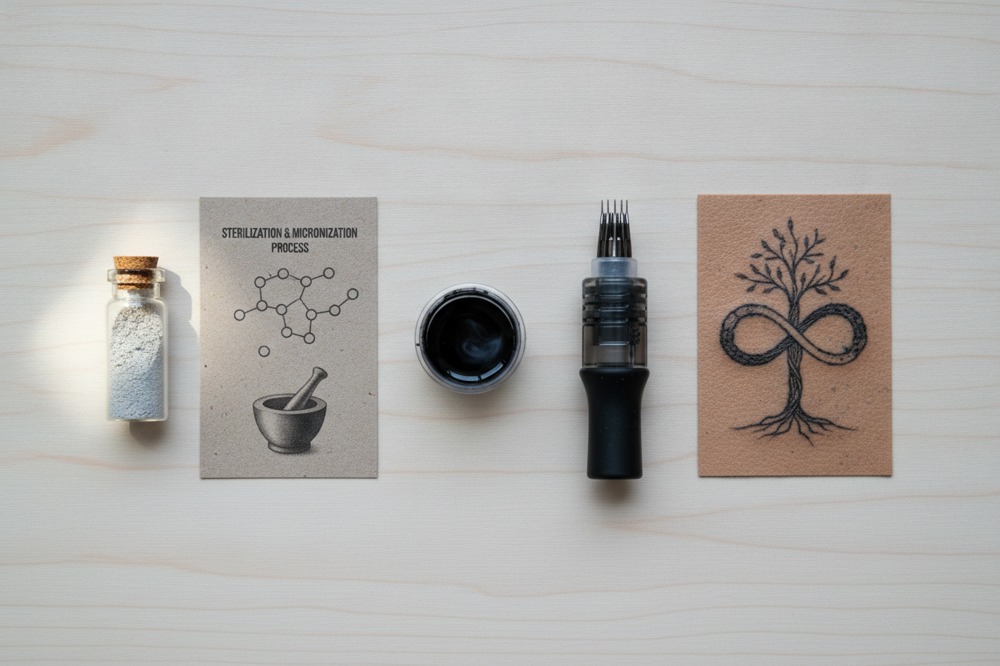
The ashes are sized down and matched so they’ll sit correctly in the ink. They’re cleaned and sterilised to clinical standards. They’re cleared of contaminants. That sequence isn’t optional and it isn’t something to cut corners on, which is a big reason people worry about whether are ashes tattoos safe at all. Done properly, with the ashes prepared this way, it’s a controlled process rather than a gamble.
I won’t spell out the exact method, but the principle is simple enough: nothing goes into your skin until it’s been through that cleaning and sterilising and the result is a stable ink you could treat like any other. Having done this work for around 20 years, I’ve refined how I prepare ashes far past where I started and the care in that stage is what the whole thing rests on.
How Much Of The Ashes Does A Tattoo Use?
Less than most people expect. Roughly a teaspoon’s worth is all that gets used and only a fraction of that ends up in the ink itself. You do not hand over a whole urn and you do not lose your loved one to the process.
That surprises people and it’s usually a relief. A common fear is that saying yes to this means giving away something you can’t get back. You’re not. The vast majority of the ashes stay exactly where they are and go home with you. If you want the full picture on quantities and sharing between several tributes, that gets covered in the ashes tattoos guide in more depth.
Because so little is needed, one person’s ashes can stretch across more than one tattoo, or across siblings who each want a piece. That’s worth thinking about before the day, not after.
What Happens To The Ashes You Don’t Use?
This is the worry nobody says out loud, so I’ll answer it directly. The ashes you don’t use go straight back to you. Nothing is kept, nothing is quietly disposed of, nothing vanishes into a back room.
The way I run it, the ashes stay in view the whole time. I take out the small amount I need in front of you, on the bench, where you can watch every step. If handling them yourself feels like too much, I’ll do that part gently while you look on, or look away if you’d rather. Either way you see what happens to them. The rest is sealed back up and it’s yours to take home the moment we’re done.
That matters more than any other detail for a lot of people. You’re trusting a stranger with something irreplaceable. Keeping it all where you can see it is the least I can do and I’d never do it any other way.
What Should You Bring So The Rest Comes Home Safely?
Bring the ashes on the day. Don’t post them, ever. There are two straightforward ways to handle it and both leave you going home with almost everything.
You can bring the whole container along and I’ll take out the small amount myself, which suits anyone who’d rather not touch the ashes at all. Or, if you’d sooner not carry the lot, measure out a small amount at home, roughly a teaspoon’s worth and just bring that. Whichever you pick, what isn’t used goes back with you. There’s a fuller rundown of the practical side in what to bring to your ashes tattoo appointment if you want to sort things before you travel.
Apart from the ashes, bring anything that helps me get the design right: a photo, a handwritten note, a signature off a card. The ashes are one half of it. The design that carries them is the other.
Is An Ashes Tattoo Permanent, And How Long Does It Last?
It’s as permanent as any tattoo and it’s a once-only thing. The prepared ashes are locked into the healed ink the same way pigment is, so they don’t fade out separately or wash away over the years.
That permanence cuts both ways and it’s worth sitting with. You get one go at this per amount of ashes. So the design, the placement and who does it all deserve proper thought up front rather than being rushed. Skin ages and any tattoo softens a little with time and I’ve covered the specifics of how long do ashes tattoos last separately for anyone weighing that up. The short version: cared for like a normal tattoo, it stays with you for good.
Because it can’t be undone, this isn’t a decision to make in a low week and act on the next morning. Take your time. The ashes aren’t going anywhere.
What Does A Cremation Ashes Tattoo Cost, And Why?
The honest answer is that it depends on the tattoo, not on some flat “ashes fee” on top. Size, detail, colour and how long it takes in the chair are what move the price, the same factors that decide the cost of any custom piece.
The ashes preparation is part of the work rather than a bolt-on surcharge, so a small, simple ashes tattoo sits at the lower end and a large, detailed one costs more, exactly as you’d expect. I’ve laid out the full picture of what shapes ashes tattoo cost uk so you can get a realistic sense before you enquire rather than a guess. What I’d say is don’t choose on price alone for something this permanent. The preparation and the care around the ashes are the bit you’re really paying for.
FAQ
Is Any Real Part Of My Loved One In A Cremation Ashes Tattoo?
Yes. A small amount of the prepared ashes is blended into the ink that’s tattooed into your skin, so the finished piece genuinely carries part of the person or pet you’ve lost. The ashes are cleaned, sterilised and cleared of contaminants first, but they are truly in there.
Can You See Or Feel The Ashes In The Finished Tattoo?
No. Once it’s healed you see the tattoo, not the ashes as a separate thing. The prepared ashes are dispersed evenly through the ink, so there’s no grainy patch or texture. Going in and healing up, it feels like any ordinary tattoo.
How Much Of The Ashes Is Needed For One Tattoo?
Roughly a teaspoon’s worth is taken and only a fraction of that ends up in the ink itself. You never hand over a whole urn. The vast majority of the ashes stay with you and go home again.
Can One Person’s Ashes Be Used For More Than One Tattoo?
Yes. Because so little is needed per tattoo, the same person’s ashes can cover more than one piece, or be shared between family members who each want their own. It’s worth planning that before the day rather than deciding on the spot.
Are Cremation Ashes Tattoos Safe To Have Done?
When the ashes are properly matched to the right particle size, cleaned, sterilised to clinical standards and cleared of contaminants before being blended into the ink, it’s a controlled process rather than a risk. The preparation is what makes it safe, which is why raw ashes should never go straight into skin.